
Stainless steel rope mesh is deceptively simple in appearance—a diamond grid of thin cables that seems to disappear at a distance. That transparency is precisely why it is specified for facades, balustrades, animal enclosures, and green walls: it encloses space without closing it off visually, with an open area of roughly 82% to 98%.
But the simplicity is optical, not structural. Rope mesh has no rigid strength of its own. It performs as a tensioned membrane: the perimeter frame or substructure absorbs the inward pull, and every selection decision—grade, rope diameter, aperture, connection type—feeds into whether the installation stays taut and safe over a 20-to-50-year service life.
This guide walks through the decisions in the order they actually matter, from environment to supplier verification.
Jump to: Key takeaways · 1. Site environment · 2. Ferrule or knotted · 3. Diameter, aperture, load · 4. Application · 5. Tensioning · 6. Supplier checks · FAQ
Stainless steel rope mesh specification in five lines
- Grade follows the environment. 304 for dry, inland, interior work; 316 or 316L within roughly 10 km of a coast, in humid or industrial air, and wherever de-icing salt is used. The 316 premium is 20%–30% — cheap next to remediating corrosion.
- Ferrule for flat engineered panels, knotted for curves. The frame and the visual intent decide; neither connection is intrinsically stronger.
- Three numbers make the specification: rope diameter (typically 1.2–4.0 mm), aperture (60 × 60 mm architectural standard), and breaking load — read for the assembled system, not the rope alone.
- Tensioning is part of the product. Panel tension commonly runs 1,400–1,800 lb per linear foot, and the perimeter frame has to be engineered for it.
- Verify before you order: an MTC for the cable grade, a documented inspection scope, a physical sample in the specified finish, and a supplier who will say which certifications it holds and which it does not.
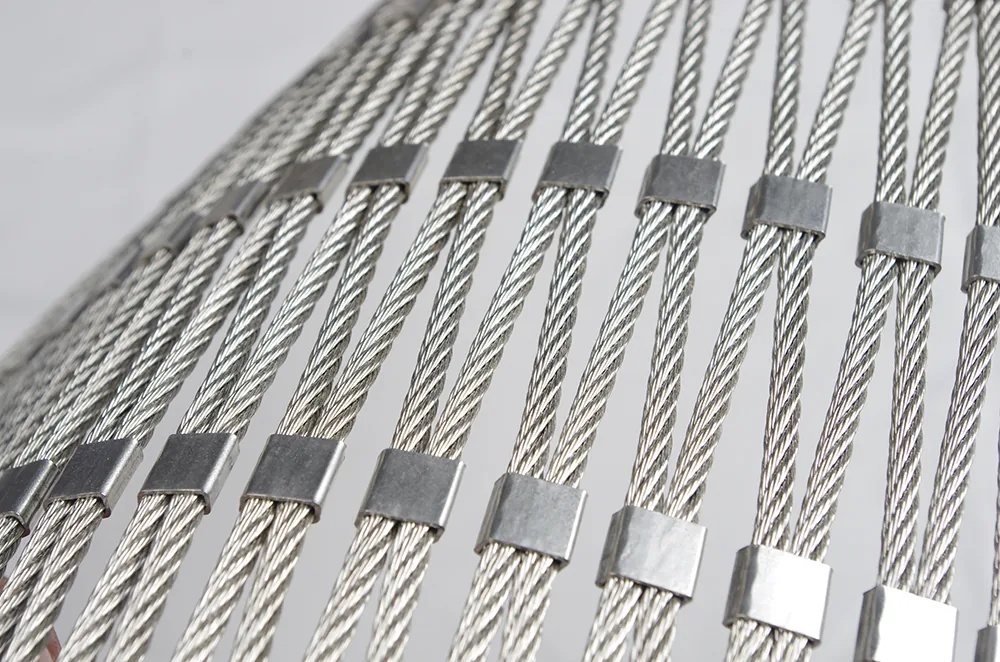
Step 1: Start With the Site Environment, Not the Price
The first question is not “304 or 316?” in the abstract—it is where will this mesh live.
Grade 304 is the economical default for interior screens, inland installations, and controlled environments without regular salt or chemical exposure.
Grade 316 (or 316L) contains molybdenum, which improves resistance to chloride-driven corrosion. It is the standard choice for coastal sites, salt-spray zones, persistently humid or tropical climates, industrial atmospheres, and de-icing salt exposure. A practical rule of thumb used in the industry is to specify 316 within roughly 10 km of a coastline; 316L is preferred where welding may create sensitization risk.
The cost difference is real but modest against the lifecycle: 316 typically carries a 20%–30% premium over 304, which is a small increment against decades of service life in the right environment. Specifying 304 where chloride exposure is routine is a false economy—corrosion on a facade or enclosure is far more expensive to remediate than the material upgrade.
| Exposure / location | Grade to specify | Why |
|---|---|---|
| Interior screens, dry inland sites | 304 | No chloride load; lowest cost per m² |
| Urban and industrial atmospheres | 316 | Sulphurous and chloride-bearing air pollution |
| Coastal, within roughly 10 km of the sea | 316 — 316L where welding is involved | Salt spray; the L grade avoids sensitisation at the weld |
| De-icing salt, pool halls, tropical humidity | 316L | A persistent chloride film sits on the wire |
| Food, marine and aggressive cleaning regimes | 316L with MTC | The documented grade becomes part of the compliance file |
The full range is made in both grades, ferruled or knotted — see the stainless steel rope mesh range for standard diameters and apertures before you write the specification.
What to ask your supplier: Request a Material Test Certificate (MTC) identifying the actual grade used for the cable and applicable mesh components. This lets procurement verify that delivered product matches the specification, not just the quotation.
Step 2: Choose the Connection Type—Ferrule or Knotted
At every intersection, the wire ropes must be joined. The two dominant methods behave differently on site.
Ferrule (swaged) mesh fixes each crossing with a small stainless steel sleeve pressed under pressure. The result is a clean, regular diamond grid with stable geometry and consistent load distribution. It is the default for architectural balustrades, facades, green walls, and premium public-facing enclosures where a precise, engineered look matters.
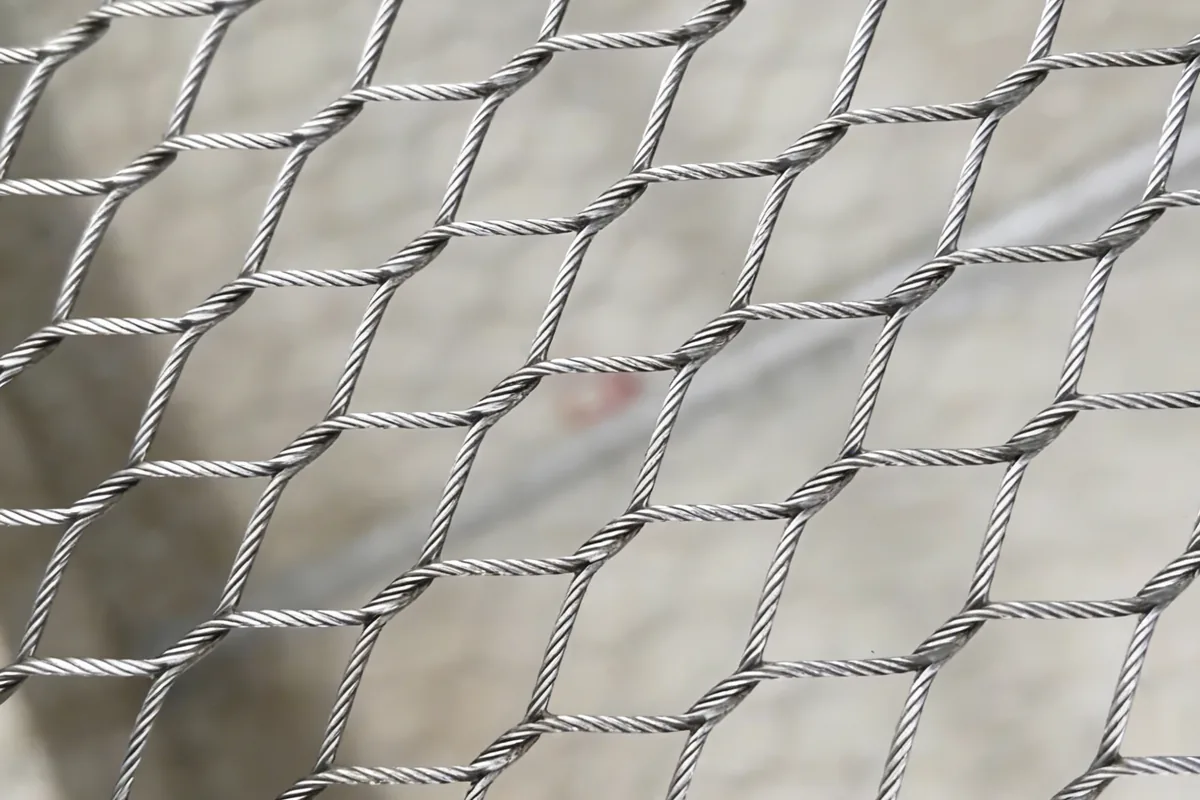
Knotted mesh interweaves ropes over and under one another without ferrules. It is more flexible, slightly lighter to produce, and better suited to complex curves, irregular frames, large aviaries, and naturalistic animal habitats.
The decision rule is straightforward: ferrule for flat or large architectural panels that need crisp geometry; knotted for curved or free-form work that needs maximum conformability. Neither is inherently “better”—the frame design and visual intent should drive the choice.
| Ferrule (swaged) | Knotted | |
|---|---|---|
| Crossing | A stainless sleeve pressed over each crossing | Ropes interwoven over and under one another |
| Grid geometry | Regular, stays square under tension | Conforms to curves and irregular frames |
| Best fit | Facades, balustrades, green walls, public-facing enclosures | Aviaries, habitat structures, radiused screens |
| Repair | One damaged cable can be replaced | Local re-weave by hand |
| Cost driver | More labour per m² | Slightly lighter to produce |
Step 3: Lock the Numbers—Rope Diameter, Aperture, and Breaking Load
Once grade and connection type are set, the mesh must be specified numerically. Three parameters interlock.
Rope diameter in architectural and enclosure work typically ranges from 1.2 mm to 4.0 mm, with 1.5 mm a common standard for architectural infill paired with a nominal 60 mm opening. Rope construction is usually 7×7 or 7×19; the choice relates to diameter and finished appearance rather than a simple “stronger/weaker” hierarchy.
Aperture (mesh opening) controls both containment and visibility. The architectural standard opening is 60 × 60 mm, with other sizes confirmed against the project drawing. For animal enclosures, the aperture must be sized to the species: smaller openings for small animals, birds, or areas close to visitors; larger openings where the enclosure houses larger animals and visibility is the priority.
Breaking load scales with diameter. Representative values run from roughly 0.63 kN for a 1.0 mm rope up to about 7.38 kN for a 7×19, 3.2 mm rope. A single 3 mm cable can have a breakage capacity in the range of 520 kg depending on construction and grade. For safety-critical applications—balustrade infill, large-span barriers—these values are not a substitute for engineering: confirm design loads and safety factors with the manufacturer and a structural engineer against the actual frame and anchorage.
A caution on “high strength” marketing: breaking load figures describe the rope itself, not the assembled system. The ferrule or knot, the perimeter fixing, and the frame often govern real-world capacity. Specify the weakest link deliberately, not by omission.
| Parameter | Typical range / standard | What it controls | What to confirm before ordering |
|---|---|---|---|
| Rope diameter | 1.2–4.0 mm; 1.5 mm common for architectural infill | Visual weight and rope capacity | Grade on the MTC and measured diameter on the sample |
| Construction | 7×7 or 7×19 | Flexibility and finished appearance | Which construction the quotation assumes |
| Aperture | 60 × 60 mm architectural standard | Containment and transparency | Species or deflection rule, against the drawing |
| Breaking load | ≈0.63 kN (1.0 mm) to ≈7.38 kN (7×19, 3.2 mm) | The rope alone — not the assembly | Ferrule, perimeter fixing and frame capacity |
| Panel tension | ≈1,400–1,800 lb per linear foot | Whether the panel stays taut | Frame, anchors and tensioning hardware |
Step 4: Match the Specification to the Application
The same product family serves very different performance demands. Treat these as starting frameworks, then confirm against the drawing and local code.
Facades and sunscreens
Transparency and wind permeability are the drivers. A 1.5 mm rope with a 60 mm opening is a common baseline; the mesh is reviewed against the facade structure and fixing points rather than selected from a catalogue. Finish options include natural bright stainless and black oxide for a low-glare surface.
Railing and balustrade infill
Deflection matters as much as strength. Independent testing has shown that a 200 lb lateral load can increase cable deflection by about 1.5 inches, with mid-span gap growth near 1 inch. Size the aperture with a deflection margin so openings stay within the applicable sphere rule—commonly 4 inches (100 mm)—and confirm the assembly with an engineer.
Zoo and aviary enclosures
Selection is species-driven. A chimpanzee enclosure, for example, may call for a 50 × 50 mm aperture with 3.2 mm rope based on bite force and impact strength; medium carnivores may use 75–100 mm openings with 4.0–5.0 mm rope. The grade should be 316/316L for coastal or humid zoos; 304 can be practical for inland, covered exhibits. Aperture-per-species detail sits in the complete guide to zoo mesh specifications, and the fixing side is covered in rope mesh for animal enclosure walls.
Green walls and facade greening
The mesh is a climbing aid, so the aperture must suit the plant’s ability to attach. Smaller mesh diameters and tighter wire spacing make it easier for climbing plants to find purchase and increase coverage area; a spacing of no more than 40 cm is a useful design constraint. Loads from plant biomass and wind must be added to the structural review—plant dead weight can be in the range of 8 kg/m², with the support system engineered accordingly — the Tokyo Metropolitan Government green-wall guideline is a useful public reference for facade greening. Aperture and fixing questions for partitions and screens more generally are answered on our metal mesh partitions page.
| Application | Grade | Rope diameter | Aperture | Connection | Governing factor |
|---|---|---|---|---|---|
| Facades and sunscreens | 304 / 316 | 1.5 mm baseline | 60 mm | Ferrule | Wind permeability, fixing points |
| Railing and balustrade infill | 304 / 316 | Per the engineer’s load case | Sized to hold the 100 mm (4 in) sphere rule under deflection | Ferrule | Deflection and mid-span gap growth |
| Zoo and aviary enclosures | 316 / 316L for coastal or humid sites | 3.2 mm (chimpanzee) to 4.0–5.0 mm | 50 mm for chimpanzees; 75–100 mm for medium carnivores | Ferrule or knotted | Bite force and impact strength |
| Green walls and facade greening | 304 / 316 | Smaller diameter, tighter wire spacing | Grid spacing ≤400 mm to help plants attach | Knotted or ferrule | Plant attachment and biomass load |
Step 5: Treat Tensioning as Part of the Product, Not an Afterthought
A common failure mode in rope mesh projects is specifying the mesh beautifully and then underestimating the tensioning system.
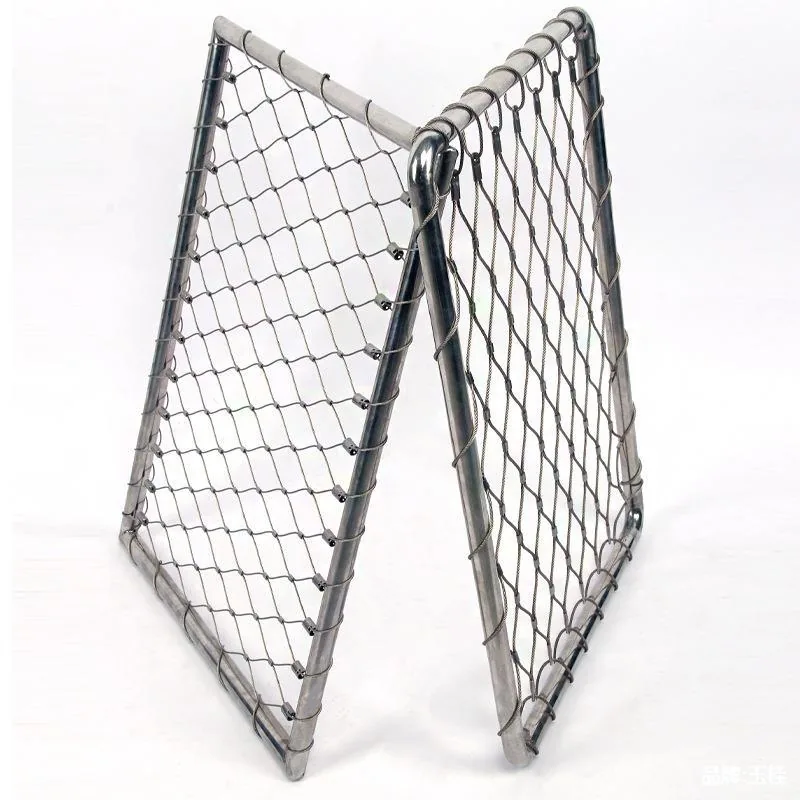
Because the mesh relies on constant tension, the perimeter frame absorbs large multi-directional inward forces. Panel tension commonly runs around 1,400–1,800 lb per linear foot, so the supporting structure must be engineered for those forces, not treated as a decorative frame. Under-tensioned mesh sags, distributes load unevenly, and will not hold the intended geometry.
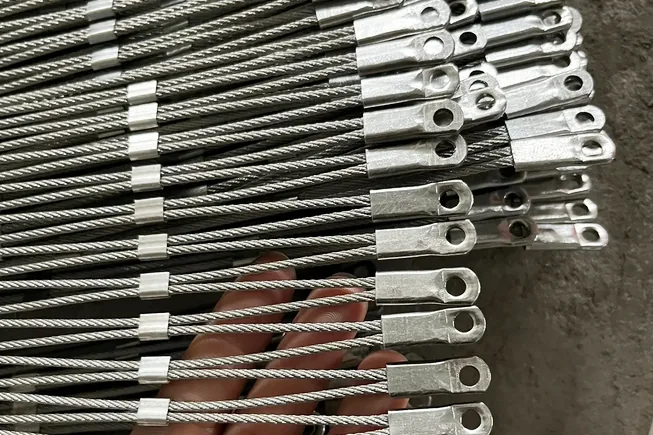
The practical implication for selection: ask the supplier what tensioning and fixing system the mesh is designed for, and confirm that turnbuckles, tensioning screws, anchors, and perimeter hardware are compatible and included or explicitly specified. A mesh panel quoted without its tensioning interface is an incomplete specification. Hardware selection is covered in more depth under metal mesh installation details.
Step 6: Verify the Supplier Beyond the Quotation
Rope mesh quality risks concentrate in the details: material grade, cable diameter, mesh opening, and finished surface. A supplier that controls these consistently is worth more than one that competes only on price per square meter.
What to request and verify:
- Material Test Certificate (MTC) for the cable grade, traceable to the mill heat number. ISO 9001-certified suppliers commonly provide MTCs as standard quality documentation.
- Documented inspection scope. Reputable factories run in-process checks on material, weave tension, dimensions, and pre-shipment appearance. Ask what is inspected and against what drawing; be cautious of suppliers who present internal inspection as third-party certification.
- Samples before production. For appearance-critical work, request a physical sample in the specified grade, rope diameter, aperture, and finish. Photographs do not reveal whether a “black” finish is oxide or paint.
- Certification claims that match the application. For safety netting, EN 1263-1 is a relevant standard; for engineered fall-protection systems, ETA assessments may apply. A supplier should be able to state clearly which certifications it holds and which it does not, rather than implying blanket compliance.
We work through the same list with every project — the Gecho factory and quality process is documented, and the MTC, inspection record and sample are released with the order rather than on request.
Price ranges vary widely with specification: commodity-grade mesh may quote in the range of $6–$10/m², while architectural and engineered panels commonly fall in the $15–$50/m² band depending on grade, diameter, aperture, and prefabrication. A low price on a high-specification panel is a prompt to verify, not a reason to celebrate.
A Compact Decision Sequence for Your Next RFQ
- Environment: inland/controlled → 304; coastal/humid/chloride → 316 or 316L. Request MTC.
- Connection: flat architectural geometry → ferrule; curved or irregular → knotted.
- Numbers: rope diameter and aperture per application; breaking load confirmed against the assembled system, not the rope alone.
- Tensioning: frame and hardware engineered for the actual tension loads; include the tensioning interface in the scope.
- Supplier: MTC, inspection process, samples, and honest certification scope—verified before the order, not after delivery.
Rope mesh rewards specification discipline. The projects that look effortless—the facade that reads as a transparent veil, the aviary where the mesh nearly disappears—are the ones where grade, geometry, and tension were resolved on paper before anything was woven.
Stainless steel rope mesh: frequently asked questions
Should I specify 304 or 316 stainless steel rope mesh?
Base the choice on the environment rather than the price. 304 is the economical default for interior screens, dry inland sites and controlled environments. 316 contains molybdenum and resists chloride-driven corrosion, so it is the standard choice for coastal sites, salt-spray zones, humid or tropical climates, industrial atmospheres and de-icing salt exposure. Industry practice is to move to 316 within roughly 10 km of a coastline, and to 316L where welding could sensitise the steel. Expect a 20%–30% premium for 316, and ask for a Material Test Certificate so the delivered grade can be verified.
Ferrule or knotted rope mesh — which should I choose?
Ferrule (swaged) mesh gives a clean, regular diamond grid with stable geometry and even load distribution, and is the default for balustrades, facades, green walls and premium public-facing enclosures. Knotted mesh interweaves the ropes, is more flexible and suits complex curves, irregular frames, large aviaries and naturalistic habitats. Let the frame design and the visual intent drive the decision instead of treating one connection as stronger than the other.
What rope diameter and aperture are standard?
In architectural and enclosure work the rope diameter usually runs from 1.2 mm to 4.0 mm, with 1.5 mm common for architectural infill, in 7×7 or 7×19 construction. The architectural standard aperture is 60 × 60 mm, and other sizes are confirmed against the project drawing. For animal enclosures the aperture is set by species, with smaller openings for small animals, birds and areas close to visitors.
How strong is rope mesh, and is the breaking load enough?
Representative rope breaking loads run from about 0.63 kN for a 1.0 mm rope to about 7.38 kN for a 7×19, 3.2 mm rope, and a 3 mm cable can reach roughly 520 kg depending on construction and grade. Those figures describe the rope, not the assembled system: the ferrule or knot, the perimeter fixing and the frame often govern real capacity. For balustrades and large spans, confirm design loads and safety factors with the manufacturer and a structural engineer.
Does rope mesh need a frame and a tensioning system?
Yes. Rope mesh has no rigid strength of its own and works as a tensioned membrane, so the perimeter frame absorbs the inward pull. Panel tension commonly runs about 1,400–1,800 lb per linear foot, which the supporting structure has to be engineered for. Under-tensioned mesh sags, distributes load unevenly and will not hold the intended geometry, so a quotation without its tensioning interface is an incomplete specification.
What documents should I ask a rope mesh supplier for?
Ask for a Material Test Certificate identifying the cable grade, a documented inspection scope covering material, weave tension, dimensions and pre-shipment appearance, and a physical sample in the specified grade, diameter, aperture and finish. Ask which certifications the supplier actually holds — EN 1263-1 is relevant to safety netting and ETA assessments can apply to engineered fall-protection systems — and expect a clear statement of what is not covered.
What does stainless steel rope mesh cost per square metre?
Commodity-grade mesh may quote in the range of $6–$10/m², while architectural and engineered panels commonly fall in the $15–$50/m² band depending on grade, diameter, aperture and the amount of prefabrication. A low price on a high-specification panel is a prompt to verify grade, diameter and tensioning scope rather than a reason to celebrate.
Related reading
- How to choose the right stainless steel cable mesh specification
- Zoo mesh: the complete buyers guide for modern animal enclosures
- Stainless steel rope mesh for animal enclosures: getting the wall fixing right
- Details of metal mesh installation
- Recent metal mesh projects and the metal mesh product range
Next step: send the application, the substructure and the drawing. We will come back with the rope diameter, aperture, connection type and the tensioning interface as one specification — request a stainless steel rope mesh quotation.