
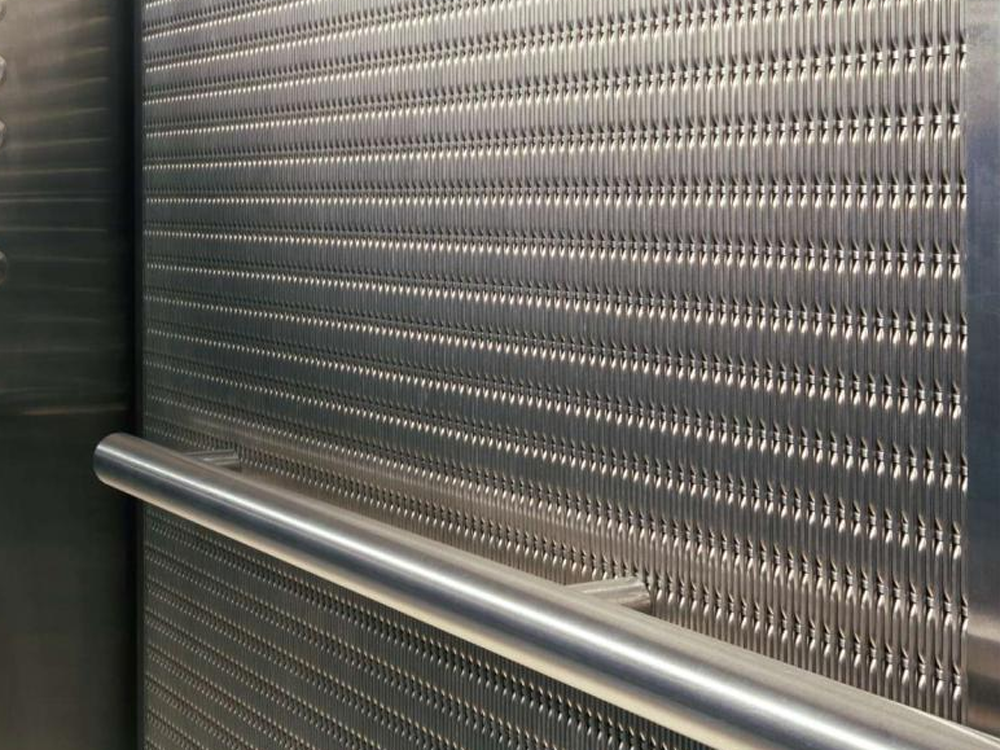
Gecho manufactures six families of architectural metal mesh: woven architectural wire mesh, metal coil drapery, stainless steel rope mesh, laminated glass metal mesh, spiral weave mesh and bespoke metal woven art mesh. All are woven at our factory in Anping County, Hebei, China in stainless steel 304 and 316, aluminum, copper and brass, and supplied as panels or curtains made to project dimensions.
Gecho has manufactured woven architectural metal mesh in Anping County, Hebei, China since 2012. The factory covers 2,000 m², employs 50 people and produces 200,000 m² of mesh a year. Panels are woven to order in stainless steel 304 and 316, aluminum, copper and brass, supplied to 50 countries, with a minimum order of 10 m² and a one-week lead time.
Metal textile art mesh
Bespoke woven copper, brass or stainless steel fabric made for feature walls, ceilings and artwork, woven to the artwork dimensions rather than cut from stock.
Read moreLaminated metal mesh
A woven metal interlayer bonded between glass plies (EVA or PVB) so the visible surface is glass, used for decorative partitions, wall linings and feature glazing.
Read moreStainless steel rope mesh
Stainless steel wire rope mesh in AISI 304 or 316, with 7×7 or 7×19 cable construction, used for balustrade infill, fall protection and animal enclosures.
Read moreMetal coil drapery
Metal coil drapery made from interlinked metal coils in magnesium alloy, aluminum, stainless steel or brass, hung on a track for ceilings, partitions and window treatments.
Read moreArchitectural woven wire mesh
Woven architectural wire mesh in stainless steel 304 or 316, aluminum, brass or copper, used as facade cladding, ceiling panels and balustrade infill.
Read moreFeatured: metal coil drapery
Metal coil drapery in stainless steel, aluminium, brass and copper: a flexible mesh curtain for partitions, ceiling features and facade screening, made to the finished drop and width.
Read moreAll architectural metal mesh products
Gecho weaves architectural metal mesh in stainless steel 304 and 316, aluminum, copper and brass at its factory in Anping County, Hebei, China. Panels and curtains are made to project dimensions, minimum order 10 m², lead time one week for stock specifications.
Facades and architectural mesh
Drapery, spiral weave and rope mesh
Projects where these products were specified are in the project gallery.
Choosing between the six families comes down to four questions: whether the mesh is fixed or has to move, how far it has to span, how much daylight has to come through, and what the surface will be exposed to.
Fixed or moving. A woven panel is tensioned into a frame or a carrier and stays where it is put. Metal coil drapery and spiral weave mesh hang from a track and can be drawn, stacked or made to follow a curve — the family to specify when the space has to change through the day.
Span and support. Wide openings with widely spaced fixings suit cable systems: stainless steel rope mesh carries load across a long span, while a woven panel needs framing at closer centres. Send the span and the substrate before the pattern is chosen.
Light and privacy. Open area — the share of the panel you can see through — decides how much daylight and view passes, and it is set by aperture, wire diameter and pitch together. Our guide to choosing a metal mesh curtain works through that relationship; the same arithmetic applies to a fixed facade panel.
Exposure and finish. Interior positions take mill, brushed, polished, PVD or powder-coated finishes. Coastal, pool and wash-down positions call for stainless 316, and where the mesh has to sit inside glass — a screen, a balustrade or a door — laminated glass metal mesh is the family to look at.
If the project is a fit-out with the opening already fixed, the applications section takes the same questions from the other end: by where the mesh is going rather than by what it is made of.