
Wide Use
Where woven metal mesh is used
Woven metal mesh is specified wherever a surface has to stay open while still doing a job: ceilings and ceiling rafts, partitions and screens, facades and sunshades, wall coverings, balustrades and enclosures. The six applications below are the ones we supply most often, and each one links to the guide or product page that covers it.
Minimum order is 10 m² and lead time is one week for standard mesh; larger or more complex quantities are quoted individually. Mesh is woven to order in stainless steel 304 and 316, aluminum, copper and brass at our factory in Anping County, Hebei, China.
Application guides
Metal Mesh Ceilings — Ceiling panels, curved panels and continuous rafts for airports, hotels and offices.
Metal Mesh Partitions & Dividers — Framed, folding, sliding and freestanding mesh screens for offices and hospitality.
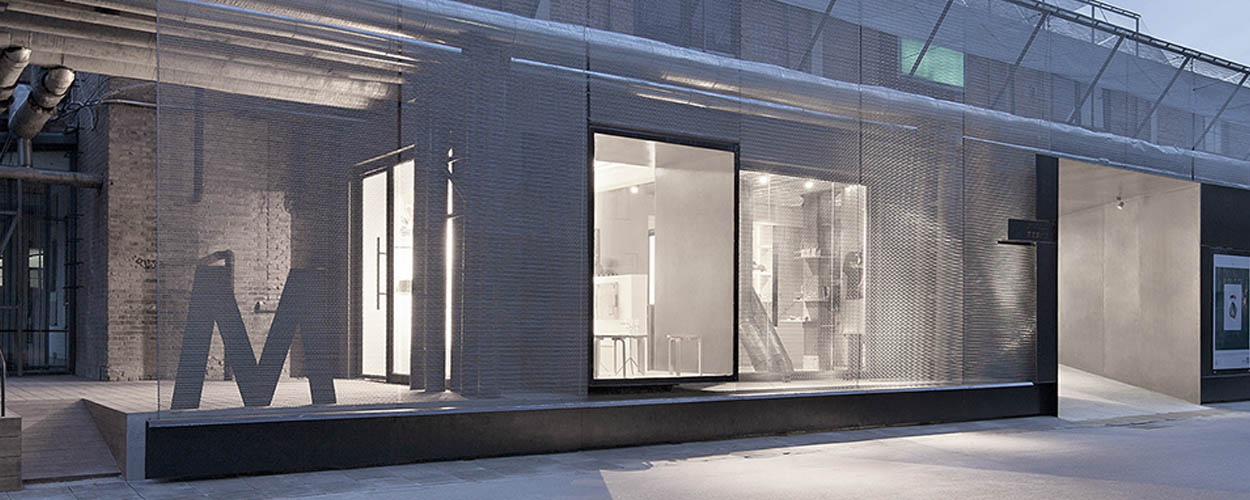
Metal Mesh Facades — Woven mesh screens and cladding for elevations, plant and car parks.
Metal Mesh Wall Covering — Wipeable woven panels for lobbies, lift interiors and feature walls.
Metal Mesh Safety & Security Screens — Rope mesh and woven panels for balustrades, enclosures and guarding.
Interior Metal Mesh Curtains — Flexible woven curtains for windows, room screening and fireplace enclosures.
Applications in completed buildings — facades, ceilings, partitions and curtains — are shown in the project gallery.
Mesh for a ceiling, a partition or a facade? See the metal mesh product range or send us the drawing for samples and a quotation.
The specification changes with the position rather than with the mesh. Each of the six applications is worked differently, and these are the questions that decide each one.
Facades and sunshades are governed by wind load, panel size and fixing. The mesh is tensioned or framed, the grade is 316 on coastal and polluted sites, and the open area is set by how much solar gain has to be cut. See metal mesh facades.
Ceilings and canopies are governed by weight and access. Panels have to be light enough for the grid or the raft, and either removable for the services above them or fixed with a coordinated access hatch. See metal mesh ceilings.
Partitions and curtains are governed by movement and stacking. Fullness, track and the space the curtain parks in matter more than the weave: a curtain at 130% fullness needs somewhere to gather when it is drawn open. See metal mesh partitions and interior mesh curtains.
Wall covering is governed by the substrate and the joints. Panels can be framed or run as a continuous tensioned skin, and the weave has to be set out so the pattern does not break across a joint. See metal wall covering.
Safety and security applications are governed by load and aperture rather than by appearance: rope mesh is sized by cable diameter and opening, and the fixing rather than the mesh decides whether it holds. See safety and security mesh.
If the material itself is the open question, the product range starts from what the mesh is made of and how it is woven.