
Gecho supplies two kinds of mesh for safety and security work: stainless steel wire rope mesh, which carries load and is used for balustrades, fall protection and enclosures, and woven wire mesh, which is used for rigid screens, guarding and anti-climb panels. Both are made to the opening rather than cut from stock, and both are available in SS304 or SS316.
Where the mesh is used
- Balustrade infill. Rope mesh between posts or a top rail, with the cable diameter and aperture chosen for the load of the span.
- Stair and void screens. Ferruled or sleeveless rope mesh closing the gap without blocking light or sightlines.
- Animal enclosures. Sleeveless rope mesh (Webnet) for zoos and aviaries, where the net is nearly invisible from a distance.
- Guarding and anti-climb. Rigid woven mesh panels on frames, for plant, machinery, car parks and service areas.
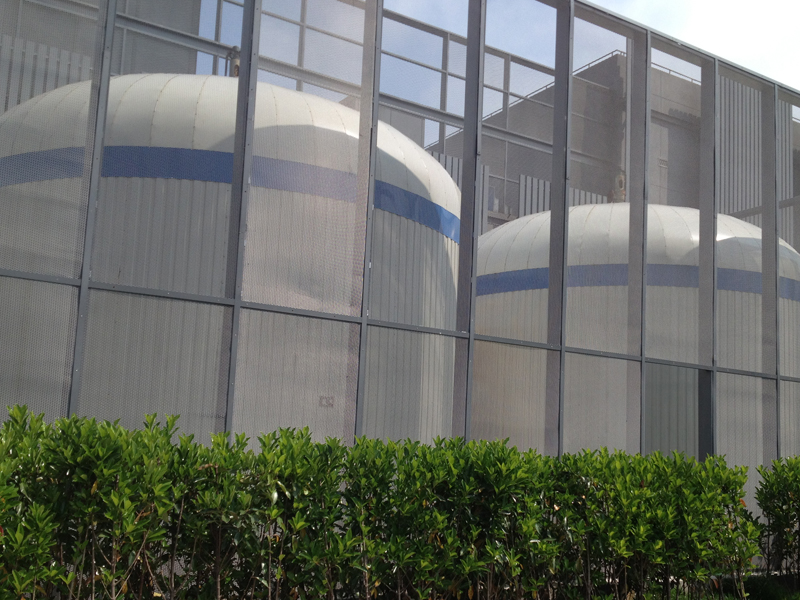
- Plant and facade screening. Woven mesh panels that hide equipment while keeping the space ventilated.
Choosing the mesh
| Type | How it is made | Used for |
|---|---|---|
| Ferruled rope mesh | Wire rope with a metal ferrule locking each crossing | Balustrades, guarding, where a fixed aperture matters |
| Sleeveless rope mesh (Webnet) | Cables woven so they hold each other without ferrules | Zoo enclosures, aviaries, more transparent screens |
| Woven wire mesh | Wire woven on a loom, supplied as rigid panels or tensioned cloth | Anti-climb screens, guarding, machine enclosures |
Specification
| Parameter | Range | Notes |
|---|---|---|
| Material | SS304, SS316 | SS316 for coastal, marine and wet areas |
| Cable / wire diameter | 1.0 mm – 4.0 mm | Load and aperture both follow the diameter |
| Aperture | 20 mm – 100 mm | Smaller aperture for containment, larger for view |
| Panel size | made to the opening | Supplied with the tensioning or frame detail |
| Fixing | posts, top rail, frame, or tensioned edge | Confirmed against the substrate |
Installation and tensioning
Safety mesh is only as good as its fixings, so the detail is agreed before manufacture:
- Set the posts and rails first. The mesh is tensioned between them, so the fixing positions come from the structural setting-out, not from the mesh panel.
- Tension to the specification. Rope mesh is tensioned evenly across the panel; uneven tension is what makes a balustrade look slack.
- Check the substrate. Whether the fixing goes into concrete, steel or a timber rail decides the anchor, and the anchor decides the load that can be carried.
Tell us the application and the load or standard that applies, and we will confirm what the mesh can carry and what documentation can be supplied with it.
FAQ
Is rope mesh strong enough for fall protection?
Rope mesh is widely used as balustrade infill and fall protection, but that is a structural application and the loading has to be confirmed for the specific span and fixing. Send the span, the posts and the load requirement and we will confirm the cable diameter and end detail.
Which grade should I specify outdoors?
SS316 for anything within reach of salt, chlorides or regular chemical cleaning: coastal and marine sites, pool areas, and many animal enclosures. SS304 is adequate inland.
Will the mesh sag over time?
Correctly tensioned stainless cable does not stretch appreciably. Sag usually comes from under-tensioning at installation or from fixings that were not designed for the load, which is why the fixing detail matters as much as the mesh.
Can it be supplied with a frame?
Yes. Woven mesh can be delivered as framed panels with the brackets already set to the opening, and rope mesh is normally supplied with the tensioning hardware for the posts or rail it will fix to.
Related products and applications
- Stainless Steel Rope Mesh — ferruled and sleeveless cable mesh
- Architectural Woven Wire Mesh — rigid woven screen panels
- Metal Mesh Partitions — space division rather than protection
- Metal Mesh Facades — plant and facade screening
Get a quote
Send the opening, the fixing detail and the load or standard that applies. We will confirm the mesh, the tensioning and the hardware, then quote. → Contact us