
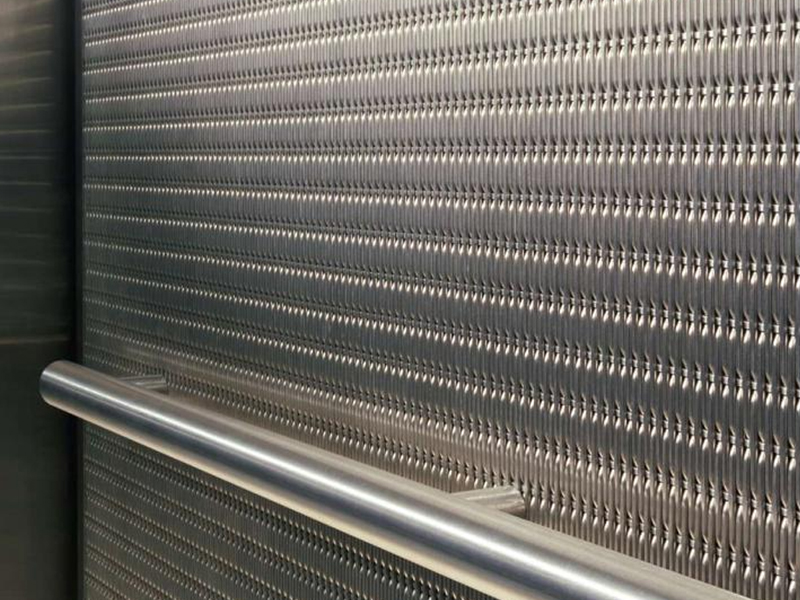
Gecho supplies woven metal mesh as a wall covering for lobbies, lift interiors, corridors and feature walls. The mesh is fixed as panels over a flat substrate or a carrier, so the wall gains a metallic surface that can be wiped down, does not scuff like paint and needs no redecoration. It is made to the wall setting-out in stainless steel 304 or 316, aluminium, brass or copper.
Why specify mesh wall covering
A wall in a public building takes more wear than any other surface in the room. Mesh answers that with metal rather than with a coating:
- Hard-wearing. There is no paint film or laminate to chip, so the finish does not deteriorate in the way a decorated wall does in a busy lobby.
- Wipeable. A damp cloth and a mild neutral detergent is the whole maintenance routine, which matters in retail, hospitality and lift interiors.
- Texture without pattern. The weave gives the wall a depth that a flat panel cannot, and the surface changes as people move past it.
- Continuity. The same mesh can continue from the wall onto the ceiling, the lift doors or a reception desk, so a fit-out reads as one material.
Formats
| Format | Description | Typical use |
|---|---|---|
| Direct-fixed panel | Mesh on a flat frame fixed back to the wall, with a shadow gap or trim at the joints | Lift lobbies, corridors, reception walls |
| Cassette | Mesh tensioned in a perimeter frame, hung or clipped onto a carrier | Large walls where panels may need removal |
| Tensioned field | Cloth stretched between top and bottom rails with no visible frame | Full-height feature walls |
| Curved panel | Panels formed to a radius for columns and curved walls | Column casings, curved reception walls |
Specification
| Parameter | Range | Notes |
|---|---|---|
| Material | SS304, SS316, aluminium, brass, copper | Brass and copper give a warmer tone |
| Wire diameter | 0.8 mm – 2.0 mm | Finer wire for a flatter, quieter surface |
| Aperture | 2 mm – 20 mm | Smaller aperture for a denser wall |
| Open area | approx. 20% – 60% | A denser wall behind the mesh reads calmer |
| Panel size | made to the setting-out | Joints set out to the wall module |
| Finish | mill, brushed, PVD, powder coat, antique | Antique finishes for period interiors |
Installation
Wall panels are set out from the wall itself, not from a standard module, because the joints have to land where the design wants them. Three details decide the result:
- The substrate. A flat backing wall or a carrier frame; the panel frame fixes back to it, so any bow in the wall shows in the joint line.
- The edge. Panels can finish with a folded edge, a shadow gap, or a metal trim; the choice also determines how the panel is removed for access.
- The joints. Vertical joints are set to the wall setting-out, horizontal joints usually line up with openings, trims and ceiling height.
Setting-out information is supplied with the order so the installer can fix the carrier before the panels arrive.
Finishes
Mill, satin-brushed and mirror-polished stainless cover most interior work. For colour, PVD gives a durable tint in gold, bronze, black and champagne without the tarnish risk of lacquer; powder coating gives a wider palette at a slightly softer surface. Brass and copper are usually left to age, unless a clear coat is specified to keep them bright.
FAQ
Can the mesh be curved around columns?
Yes. The cloth follows a radius when it is tensioned on a curved frame, and column casings are normally made as two or more curved panels with a joint on the least visible line.
Does it need a solid wall behind it?
Not necessarily, but it needs a flat substrate. On a stud wall the frame fixes to the studs; over a rough wall a carrier is set out first, so the finished face is flat and the joints stay straight.
How is it cleaned?
Dust it, then wipe with a damp cloth and a mild neutral detergent. Avoid abrasive pads and aggressive cleaners, which dull brushed, anodized and PVD finishes.
Can it be used in a lift?
Yes — lift lobbies and cab walls are a common use, because the mesh takes daily contact and can be wiped down. In cabs the panels are normally thinner and the edges are folded back to protect hands.
Related products and applications
- Architectural Woven Wire Mesh — the material for wall covering panels
- Metal Mesh Facades — the same idea on the outside of the building
- Metal Mesh Partitions — screens that divide a space
- Metal Woven Art Mesh — for feature walls with a pictorial pattern
Get a quote
Send the wall elevation with the panel module and the finish. We will confirm the weave, the joint layout and the fixing detail, then quote. → Contact us